Nashon Pkiach leads Kenya’s medal hopes in the nine-man final, but Australia’s Daniel Williams and Morocco’s Imad Bouchajda have faster season’s bests, setting up a race where qualifying form may count for little once the medals are decided.
By Robert Kibet
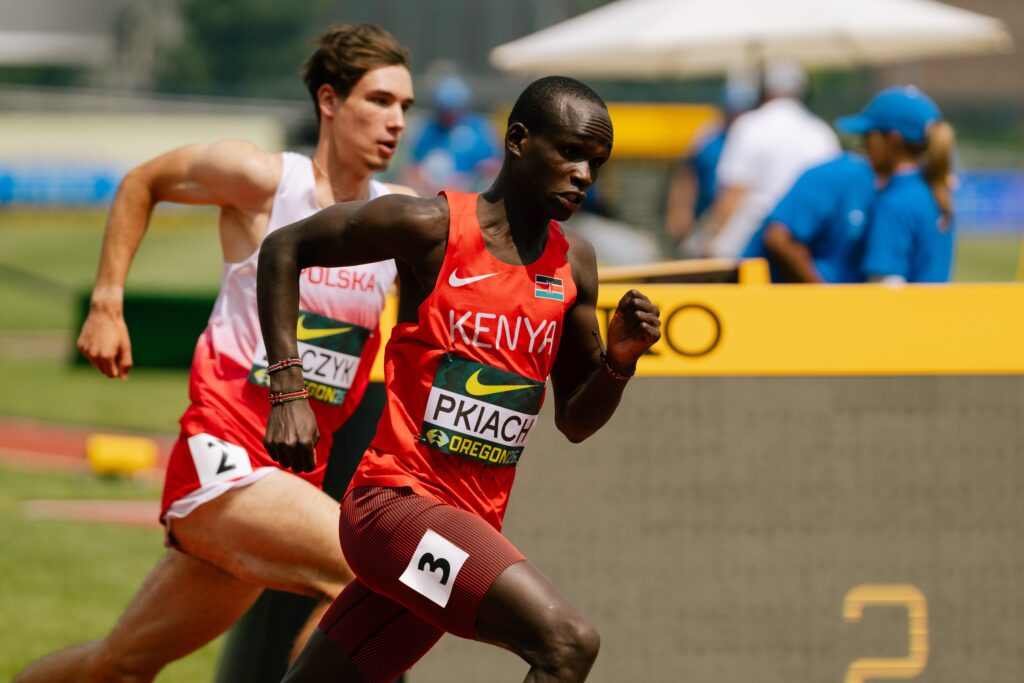
EUGENE, Oregon, Aug 8 2026—Kenya will have two runners in the men’s 800m final at the World Athletics Under-20 Championships in Oregon, with Nashon Pkiach and Collins Tajewou carrying the country’s medal hopes into a nine-man showdown at Hayward Field.
The final is scheduled for 7.08pm Pacific Time on Saturday 8 August, corresponding to 5.08am on Sunday 9 August in Nairobi.
For Kenya, the intrigue is not simply that two athletes have reached the final. It is whether Pkiach and Tajewou can turn promising form into medals when the race resets and nine athletes line up for the championship deciding two laps.
Pkiach carries Kenya’s stronger hand
Pkiach owns a 1:45.82 personal and season best, produced in Oregon on 7 August. That makes him the faster of Kenya’s two finalists and third-fastest on the 2026 season list among the athletes in Saturday’s final.
But two finalists have gone quicker.
Australia’s Daniel Williams arrives with 1:44.37, while Morocco’s Imad Bouchajda has run 1:44.38. Slovenia’s Benjamin Lakošeljac follows at 1:46.17, placing Pkiach firmly among the leading medal contenders on paper.
Tajewou’s 1:46.18, meanwhile, puts him further down the statistical order. Yet the gap between season’s bests and the final result can be considerable over 800 metres.
A final measured against exceptional standards
The nine athletes are competing in an event with an extraordinary record book.
The World U20 record stands at 1:41.73, set by Botswana’s Nijel Amos in London in 2012. The current 2026 World U20 leading mark is 1:42.08, set by American Cooper Lutkenhaus in Oslo in June. Neither Amos nor Lutkenhaus is in Saturday’s final, but their marks provide a sense of the ceiling of the event.
There is also a distinctly Kenyan benchmark.
Emmanuel Wanyonyi’s 1:43.76 remains the World U20 Championships record, set in Nairobi in 2021. It is a mark that sits only 1.39 seconds outside the world U20 record.
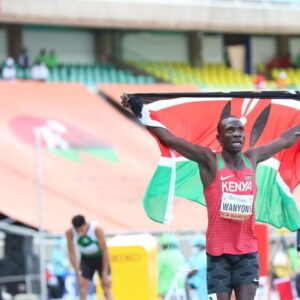
Kenya’s depth becomes even clearer in the all-time U20 list. Timothy Kitum is ranked at 1:42.53, Wanyonyi at 1:42.80, Abraham Kipchirchir Rotich at 1:43.13 and Leonard Kirwa Kosencha at 1:43.40.
That history puts Saturday’s finalists into perspective.
Pkiach’s 1:45.82 and Tajewou’s 1:46.18 are some distance from the exceptional Kenyan marks of the past, but neither athlete needs to approach those times to win a medal in Oregon.
And that is precisely what makes the final difficult to predict.
The fastest on paper may not finish first
The fastest finalist is Williams at 1:44.37, followed almost identically by Bouchajda at 1:44.38. Pkiach is 1.45 seconds behind Williams on season’s best, while Tajewou is 1.81 seconds adrift.
Those differences look significant on a results sheet.
They may mean much less once the athletes are racing shoulder to shoulder.
An 800m final can be transformed by the pace, positioning and the timing of the final move. A slower opening can compress the field and bring more athletes into contention, while a fast first lap can expose those without the speed to respond when the race accelerates.
That is where Tajewou’s opportunity lies.
He may not have the fastest mark in the field, but a well-positioned athlete can overturn the form book in the final metres.
Two Kenyans, three medals
For Pkiach, the task is different.
His 1:45.82 shows he has already produced the speed required to be considered a genuine medal contender. The challenge now is to reproduce that level under championship pressure and avoid allowing the race to dictate his position.
For Tajewou, the target is to stay connected for as long as possible and turn the final into a race of execution rather than rankings.
The field includes Spain’s Alejandro Rios at 1:46.66, Uganda’s Shafeck Murungi at 1:46.41, Muñoz at 1:47.64 and Australia’s Harry Halleen at 1:48.17.
Three medals are available.
The records belong to the history books. The world lead belongs to Lutkenhaus. The fastest season’s best in this final belongs to Williams.
But none of them can win Saturday’s race from the stands.
At Hayward Field, Pkiach and Tajewou will have two laps to create their own place in Kenya’s long 800m story.
And the athlete who gets the final 200 metres right could leave Oregon with the medal that the numbers did not necessarily predict.