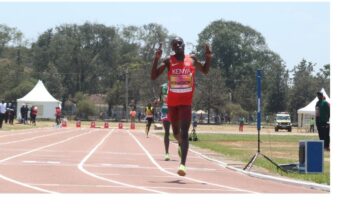
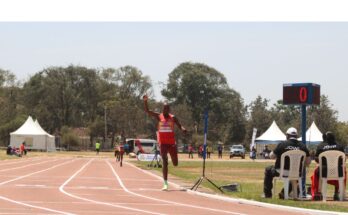
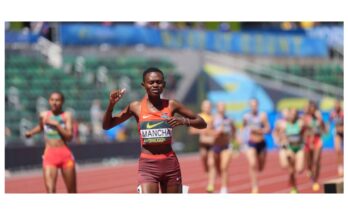
Emmanuel Lemiso Someki and Nicholas Kitum Losiwareng fought back from deep in the field to win silver and bronze, while Kenya swept gold in both the men’s and women’s 1500m finals
By Robert Kibet
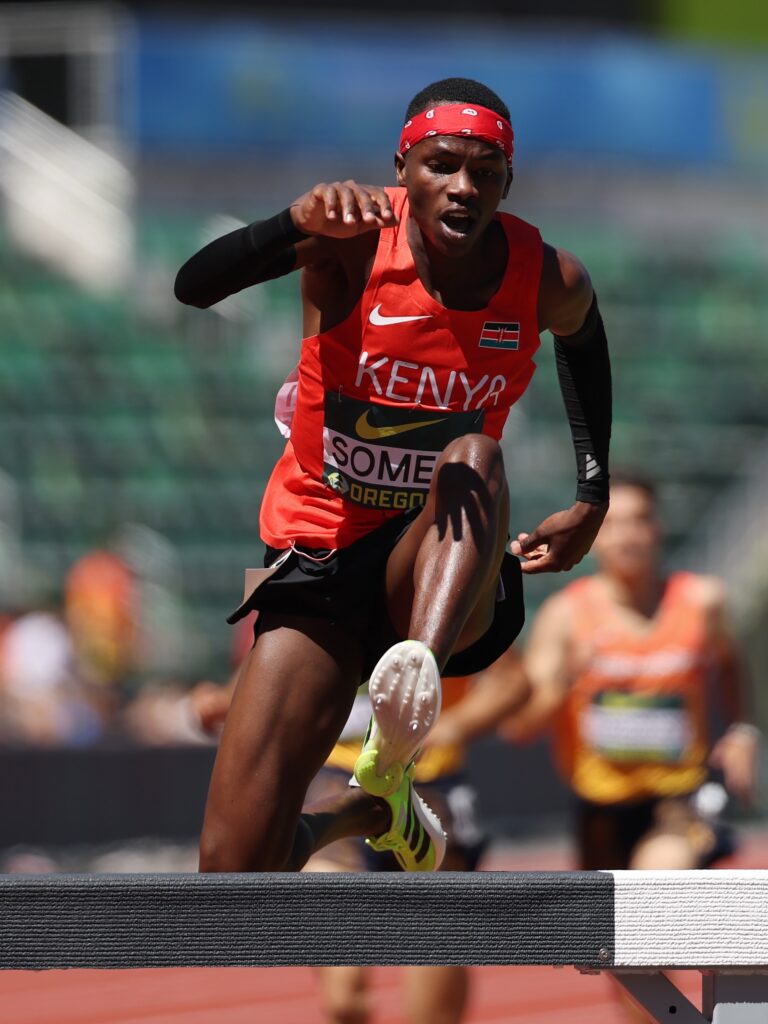
Kenya’s young middle-distance runners have sent a powerful message from Eugene.
The country may no longer have the luxury of assuming that its traditional events will remain exclusively Kenyan.
But it still has the talent, resilience and competitive instinct to fight for the podium.
That was the message from a dramatic men’s 3000m steeplechase final at the 2026 World Athletics Under-20 Championships, where Spain’s Bakr El Asri won gold in an under-20 area record of 8:28.35.
Kenya’s Emmanuel Lemiso Someki took silver in a personal best of 8:32.81, while Nicholas Kitum Losiwareng produced a desperate late surge to claim bronze in 8:38.05.
For Kenya, the result was both a medal success and a warning.
The world is getting closer.
Caption: Someki and Losiwareng stayed patient early before launching their challenge for the podium.
Alt text: Emmanuel Lemiso Someki and Nicholas Kitum Losiwareng racing in the men’s 3000m steeplechase in Eugene.
Credit: [Photographer/Agency]
From 13th to silver
Someki’s race was anything but straightforward.
At 400 metres, he was 13th in 1:08.93. Losiwareng was 11th in 1:08.81.
El Asri, meanwhile, was already at the front in 1:07.38.
The Spaniard looked comfortable, while the Kenyans stayed in the congested field and avoided unnecessary trouble over the barriers.
By 1,000 metres, the gap had almost disappeared.
Someki was 10th in 2:58.41, while Losiwareng was 12th in 2:58.56. El Asri was second in 2:58.02.
Then the race changed.
At 1,500 metres, Someki had moved into first in 4:25.96.
Losiwareng was second in 4:26.32.
El Asri had slipped to fifth in 4:27.63.
For a moment, Kenya appeared to have taken control.
El Asri had moved into second at 5:48.98, with Losiwareng third in 5:49.33.
Kenya was still in control.But El Asri had not gone away.
Spain answers Kenya
With 200 metres remaining, the order had changed again.
El Asri was first in 7:57.06.
Someki was second in 7:58.75.
Spain’s Marti Torregrossa was third in 8:03.37.
Losiwareng was fourth in 8:08.11.
The Spaniard had overturned a 2.69-second deficit to Someki at 2,000 metres and established a 1.69-second lead with the finish approaching.
El Asri crossed the line in 8:28.35, setting an under-20 area record.
Someki held on for silver.
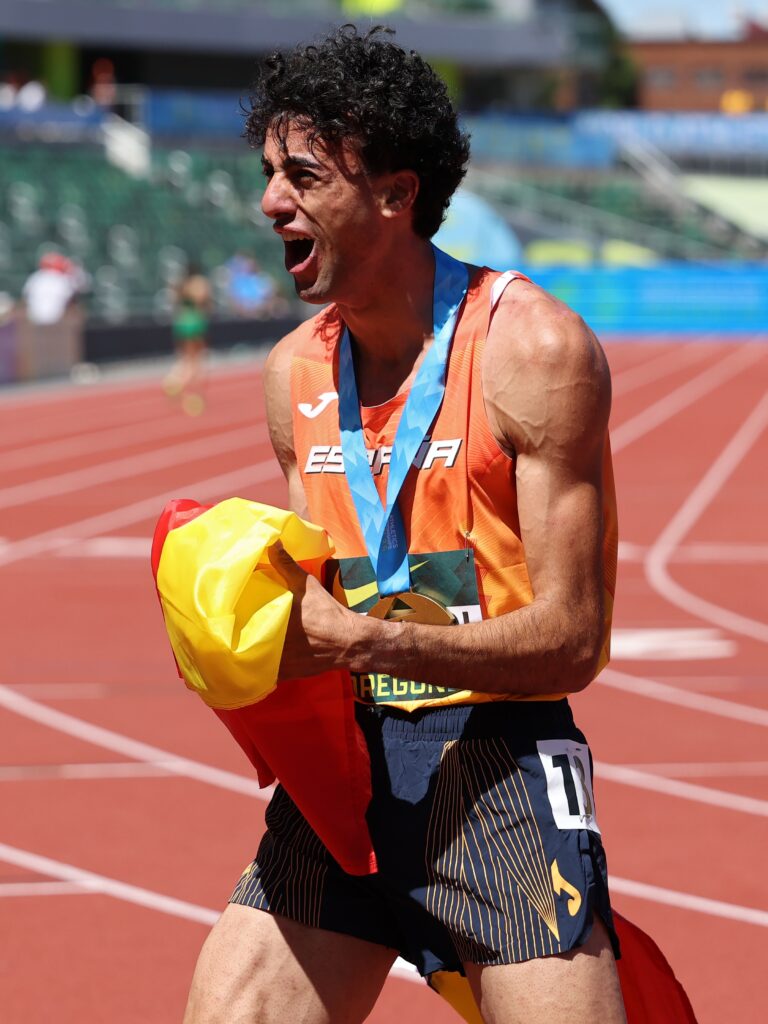
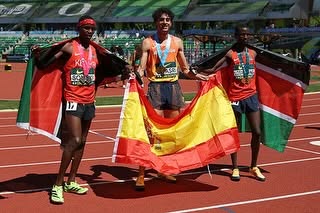
El Asri said he had prepared for either a fast or slow race.
He initially wanted to accelerate the contest but realised that forcing the pace too early could make him lose control.
“I knew the Kenyans would not let the work be easy, and I had to give everything,” he said.
The comment underlined the competitive pressure Kenya had placed on him.
El Asri knew he was not simply racing the clock.
He was racing Kenya’s steeplechase tradition.
“I came here so emotional and I wanted to bring the medal home,” he said.
He later joked that if Spain can be so good at football, there is no reason it cannot be good at track and field.
A bronze won by centimetres
Behind the two leaders, another battle was unfolding.
Losiwareng had slipped to fourth with 200 metres remaining.
Torregrossa was ahead of him.
But the Kenyan found another reserve of strength.
He crossed the line in 8:38.05.
Torregrossa followed in 8:38.13.
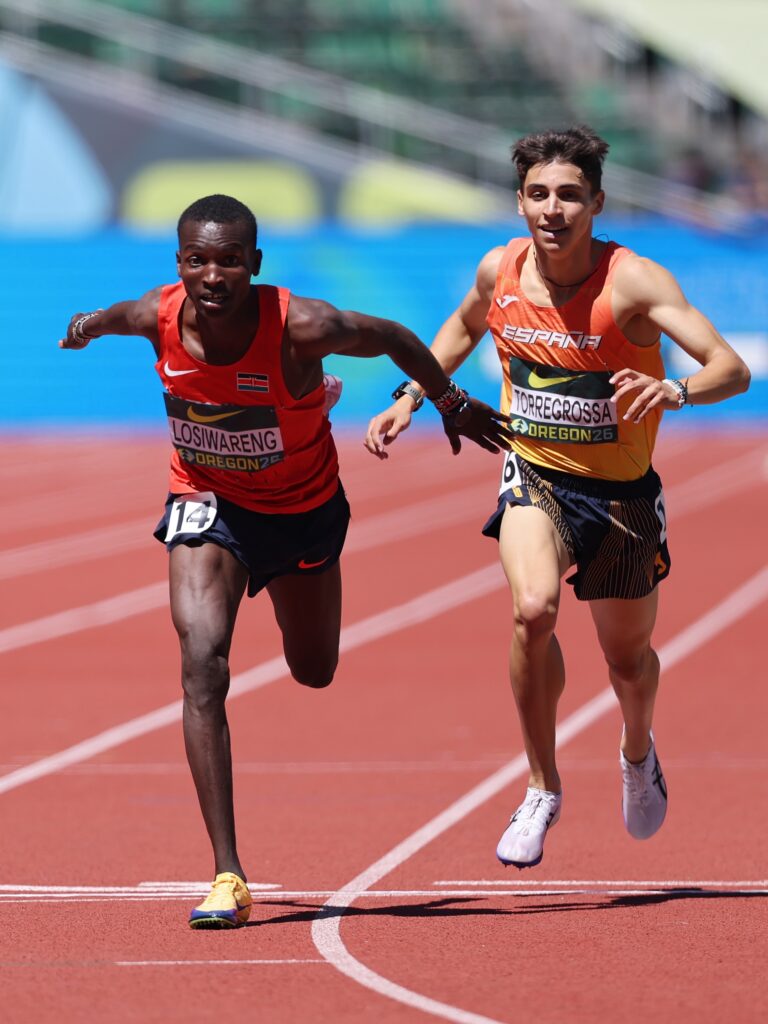
The margin was just 0.08 seconds.
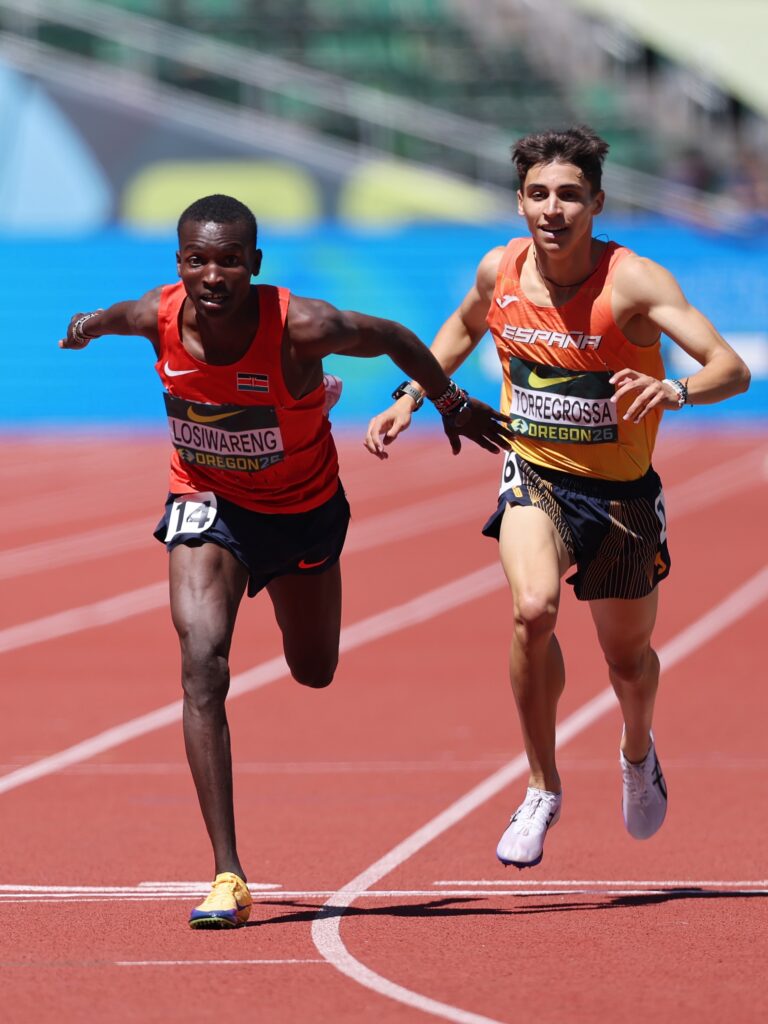 Nicholas Kitum Losiwareng produced a late surge to beat Spain’s Marti Torregrossa by 0.08 seconds for bronze. Photo:World Athletics
“I am grateful to have this position,” Losiwareng said. “I found extra strength to overtake the Spanish athlete at the line.”
Torregrossa confirmed the impact of the Kenyan surge earlier in the race.
“The Kenyan, Emmanuel Lemiso Someki, upped the pace and we tried to follow him,” he said.
“I lost my strength and the last 200m became very long.”
The Spanish runner was left fourth, while Kenya walked away with two medals.
Someki’s silver and a personal best
For Someki, the result carried mixed emotions.
He had gone into the final trying to maintain Kenya’s tradition in the event.
“I tried my best to defend the title for Kenya but it is not easy,” he said.
“I still have a silver with a personal best.”
His 8:32.81 was a personal best.
It was not the gold medal Kenya wanted.
But it was another podium finish for a country whose steeplechase tradition is being challenged by an increasingly global field.
Kenya’s 1500m response
The steeplechase result came against an even stronger Kenyan showing in the 1500m.
In the men’s final, Wilson Chepkoech won gold and Daniel Kapaiko took silver.
In the women’s final, Josphine Mancha won gold while Caren Chepchirchir claimed bronze.
Together, the 1500m finals produced four Kenyan medals, including two golds.
The steeplechase added another two.
The results underline the depth of Kenya’s junior middle-distance programme.
But they also reveal something else.
In the 1500m, Kenya produced champions.
In the steeplechase, Spain produced the champion.
That contrast matters.
Kenya still has the talent. The world has the ambition.
The steeplechase final offered a glimpse of where the event may be heading.
At 400 metres, Spain led and Kenya was deep in the pack.
At 1,500 metres, the Kenyans had seized control.
At 2,000 metres, Someki was still leading.
With 200 metres to go, El Asri had reclaimed the advantage.
At the finish, Spain had gold.
Kenya had silver and bronze.
This was not a Kenyan collapse.
It was a warning.
The rest of the world is becoming more technically proficient, more tactically confident and increasingly willing to challenge Kenya in events once regarded as its territory.
That makes junior development even more important.
Athletics Kenya’s Junior Holiday Camps are part of the wider effort to identify talent, strengthen development pathways and keep young athletes engaged during school breaks.
The camps should not be presented as the direct reason behind these particular medals.
But the Eugene results demonstrate why Kenya needs a deep and continuously developing pipeline.
The next generation must possess more than endurance.
It needs speed.
Technical efficiency.
Tactical intelligence.
And the ability to respond when a race suddenly changes.
El Asri showed that in Eugene.
So did Someki.
So did Losiwareng.
Kenya is still producing champions.
But the world is learning how to challenge them.
And the next race for Kenyan athletics will not only be on the track.
It will be about how effectively the country develops the young athletes coming behind them.