Joyline Chepkemoi’s personal-best bronze and Cynthia Chepkirui’s fourth-place finish at the World Athletics U20 Championships offered further evidence that Athletics Kenya’s investment in grassroots development is producing a new generation capable of restoring the country’s distance-running supremacy.
By Robert Kibet
EUGENE, Oregon Aug 6 2026—For much of Thursday evening in Eugene, Kenya looked firmly on course to challenge for the women’s 5,000m title.
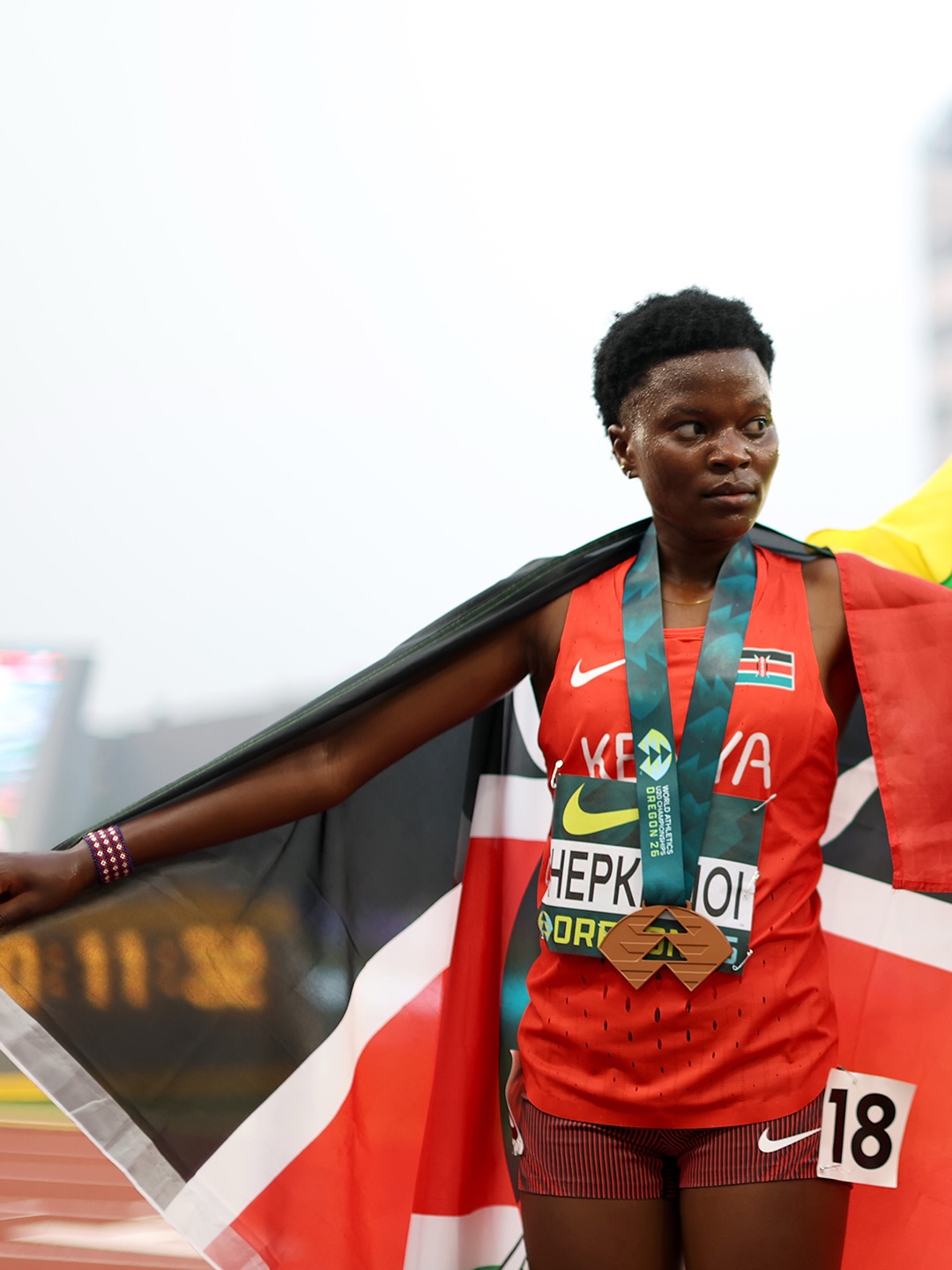
Joyline Chepkemoi and Cynthia Chepkirui remained tucked inside the lead pack through the opening 4,000 metres before Uganda’s Charity Cherop unleashed a devastating final-kilometre surge to claim gold in 15:03.88. Ethiopia’s Shito Gumi took silver in 15:07.91, while Chepkemoi earned bronze in a personal best of 15:09.08, with Chepkirui placing fourth in 15:14.86.
“I have done good so I am so happy. I was not expecting this but I have done good,” said Chepkemoi after securing the first global medal of her career.
“I am proud of my country and I thank everybody who supports us. I want to thank my mentor Beatrice Chebet and I would like to tell her I will run like her.”
A race defined by patience
The championship final unfolded as a tactical contest rather than a battle against the clock.
Gumi assumed responsibility for the early pace, leading the field through 2,500m in 7:42.38, but only 0.44 seconds separated the first five athletes. Cherop sat comfortably on the Ethiopian’s shoulder, while Sweden’s Carmen Cernjul occupied third. Chepkirui and Chepkemoi followed closely in fourth and fifth, conserving energy for the decisive stages.
Little had changed by 3,000m.
Gumi reached the mark in 9:16.44, followed by Cherop (9:16.53), Cernjul (9:16.65), Chepkirui (9:16.69) and Chepkemoi (9:16.81). Television commentators observed there were “no surprises” as the favourites remained locked together, each waiting for someone to make the first decisive move.
Cherop makes her move
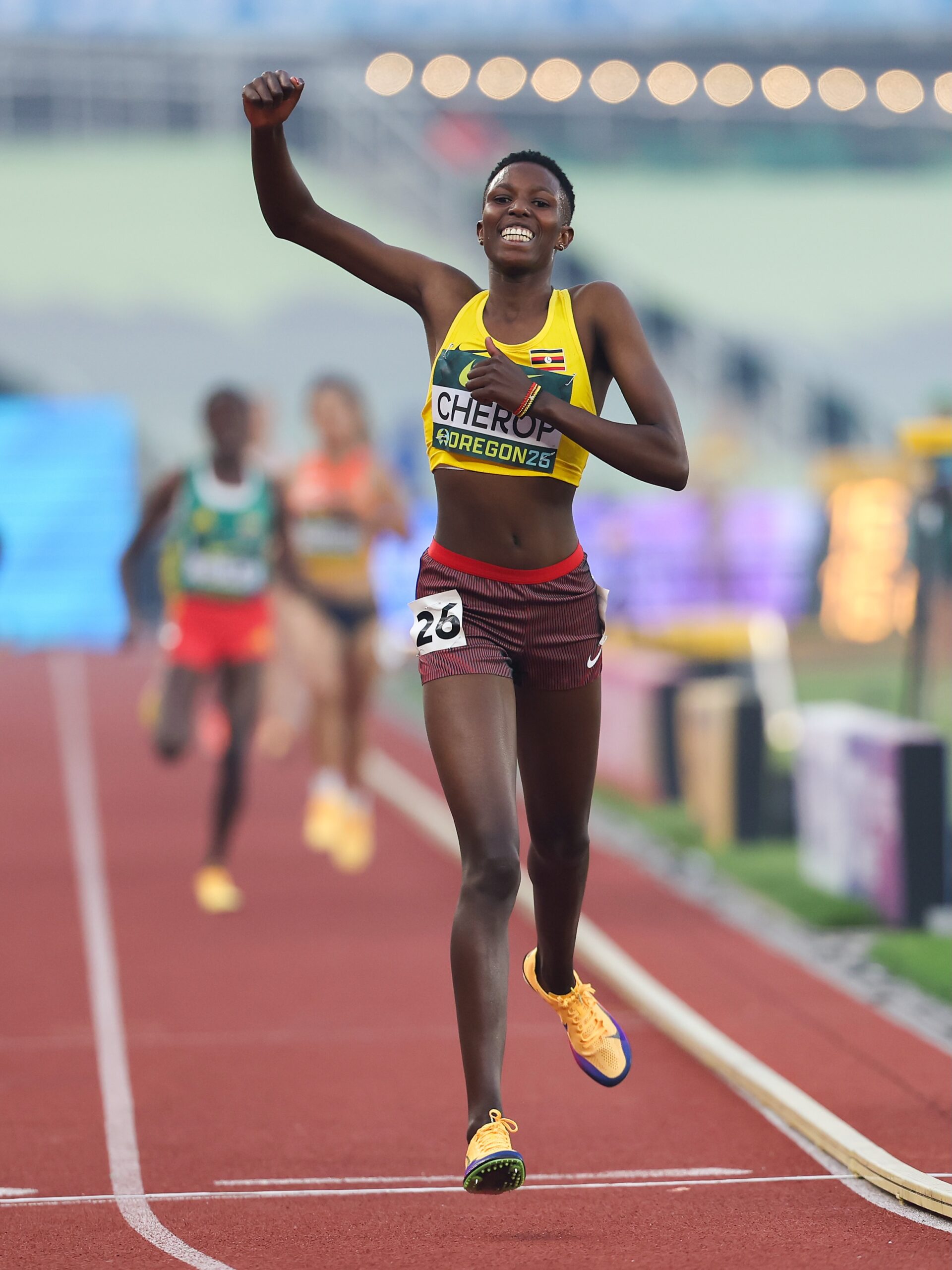
The race changed approaching the final kilometre.
Having spent much of the evening tracking Gumi, Cherop edged to the front and passed 4,000m in 12:12.27. Gumi followed in 12:12.54, while Chepkemoi (12:13.28) and Chepkirui (12:13.56) remained little more than a second behind.
“This is the beginning of her bid for glory,” one commentator observed as Cherop steadily increased the tempo.
Rather than producing one explosive burst, the Ugandan gradually squeezed the pace until the lead group finally splintered. The commentators described it as “the long run for home” as Cherop’s relentless acceleration broke the resistance of her rivals.
“I am so grateful. I am so happy,” Cherop said afterwards.
“I put my mind to it and I wanted to get that medal. Now I am waiting for the 3,000 metres. I want to focus, no pressure and I want to win, run and do my best.”
Silver battle goes to the wire
Cherop’s title was effectively secured before the final bend, but the fight behind her remained fiercely contested.
At the 4,800m mark, with only 200 metres remaining, Chepkemoi had moved into second place in 14:34.31, just 0.05 seconds ahead of Gumi. Chepkirui remained fourth as Kenya briefly occupied silver-medal position.
Gumi, however, summoned one final response down the home straight to reclaim second place, leaving Chepkemoi to celebrate a hard-earned bronze and personal best. Chepkirui crossed moments later to complete a strong evening for Team Kenya.
“I thank my God. I am very happy to become second,” Gumi said.
“The temperature was very, very challenging for me but I am happy getting this silver medal. I am the coming generation for Ethiopia to continue at the Olympic Games and World Championships. I want to continue that legacy for the future.”
The television commentators remarked that Kenya’s pair were “breathing fire” down Gumi in the closing stages, highlighting how fiercely the medals were contested until the finish.
Rebuilding Kenya’s distance-running future
Beyond the bronze medal, Athletics Kenya sees performances such as those of Chepkemoi and Chepkirui as validation of a long-term strategy to replenish the country’s distance-running talent.
Over the past two years, the federation has rolled out more than 55 Junior Holiday Camps across the country to identify promising athletes at an early age and guide them through structured coaching, athlete welfare, safeguarding and clean sport education.
The initiative is reinforced by Athletics Kenya’s Kids’ Athletics framework, which introduces children to the sport before progressing talented youngsters into competitive pathways. Together, the programmes are designed to widen Kenya’s talent base and build athletes capable of succeeding on the world stage.
Athletics Kenya Youth Development Director Barnaba Korir believes the performances in Eugene demonstrate that the strategy is beginning to bear fruit.
“These boys and girls have done us as a country proud. Harvesting four medals on the opening day is no mean feat, and it shows how effective our Junior Holiday Camps can be as we continue building towards the Los Angeles Olympic Games.”
The women’s 5,000m final also underlined East Africa’s enduring grip on global distance running. Uganda claimed gold, Ethiopia silver and Kenya bronze, with all three medallists speaking of carrying their nations’ traditions into the future.
For Athletics Kenya, that future is increasingly being shaped not by chance, but through deliberate investment in youth. Chepkemoi’s breakthrough bronze and Chepkirui’s fourth-place finish may not have delivered the title, but they offered compelling evidence that the federation’s grassroots model is nurturing a generation capable of returning Kenya to the summit of world distance running.