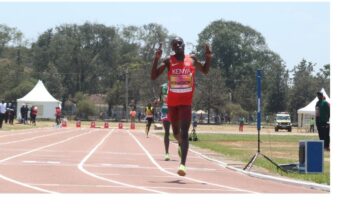
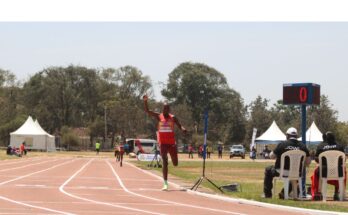
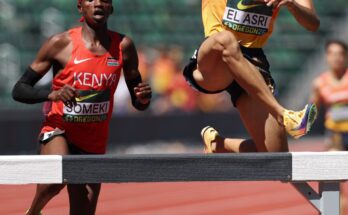
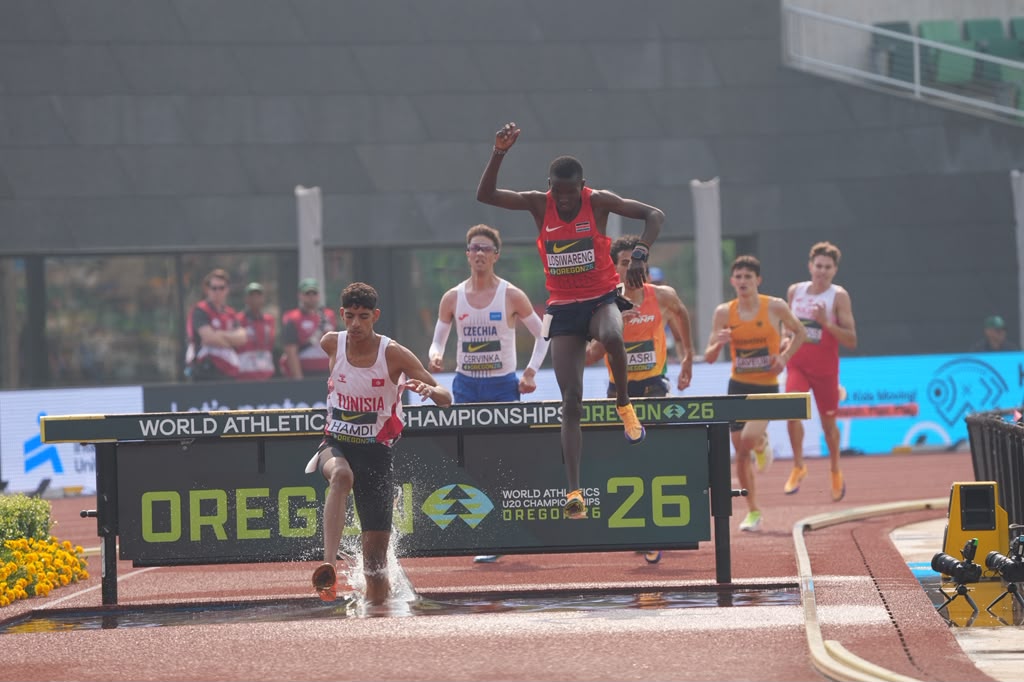
 Nicholas Kitum Losiwareng clears the water jump at Oregon26.
Nicholas Kitum Losiwareng and Emmanuel Lemiso Someki won their heats as two 18-year-old Kenyans combined controlled pacing, patience and late-race speed at Hayward Field
By Robert Kibet
Two heats, two Kenyan winners
EUEGEN, Oregon, Aug 7 2026—Kenya’s steeplechase pedigree was on display on day two of the World Athletics U20 Championships 2026, as 18-year-olds Nicholas Kitum Losiwareng and Emmanuel Lemiso Someki each won their heats to advance to the men’s 3,000m steeplechase final at Hayward Field.
Losiwareng produced the quicker of the two winning marks, crossing in 8:45.26, while Someki followed with 8:47.61.
But the times tell only part of the story.
In a championship steeplechase, where barriers, water jumps and tightly packed fields can turn a qualifying race into a test of risk management, both Kenyans showed composure when qualification mattered most.
Losiwareng puts qualification first
Losiwareng controlled the first heat from the leading positions, avoiding the congestion that can make the early stages of a steeplechase costly.
He eventually secured the win in 8:45.26, ahead of Tunisia’s Mohamed Ali Hamdi in 8:47.76 and Algeria’s Soheib Dissa in 8:48.60.
For Losiwareng, there was little reason to spend more than necessary.
“Being heats, I was looking for qualification.”
The 18-year-old is also looking beyond Eugene. The championships mark the end of his U20 journey before he moves into the senior ranks next year.
His ambitions extend even further.
“After this championships, I will embark on my training in preparation for the 2028 Los Angeles Summer Olympics.”
For now, however, his immediate objective is a medal in Eugene.
Someki plays the waiting game
Heat two provided a more detailed illustration of tactical risk management.
Someki was among the leaders through 400m in 1:14.96, with Morocco’s Mahfoud Bellal and Spain’s Marti Torregrossa close behind.
But leading did not mean Someki intended to remain exposed at the front.
The 18-year-old explained that he deliberately moved into the middle of the pack during the early stages, conscious of the risks associated with a crowded steeplechase.
“I led the pack but maintained, playing safe by being in the mid pack in the early stages as I treaded carefully to avoid any injuries.”
That decision kept him within reach while reducing the need to fight for every position over the barriers.
By 1500m, Someki was at 4:30.38, still firmly involved as the field remained compact.
Spain’s 19-year-old Marti Torregrossa, who finished fourth, described a similar philosophy.
“The race was good, I went calm without spending that much energy to reserve it for the final.”
The message from both finalists was similar: the qualifying heat was not the place to spend everything.
When the race changed
The tactical picture shifted with two laps remaining.
Uganda’s Jeremiah Kwemoi, who had started more conservatively, moved to the front at 6:29.53.
Someki followed just 0.19 seconds behind at 6:29.72.
Rather than immediately fighting to reclaim the lead, he stayed close.
That patience left him positioned to respond when the decisive phase arrived.
The closing move
The race finally opened up in the closing stages.
Someki produced his decisive acceleration and moved away from the chasing group before crossing the line in 8:47.61.
The performance underlined one of the central demands of championship steeplechase: controlling the race does not always require leading it.
Sometimes it means knowing when to lead, when to follow and when to attack.
Someki’s heat suggested he understood all three.
Two Kenyans, two routes to the final
The two heat victories revealed slightly different tactical strengths.
Losiwareng showed the value of front-running control and consistent positioning.
Someki demonstrated patience, positional awareness and the ability to respond when the race demanded it.
Their winning times were separated by only 2.35 seconds, but their routes to victory were different.
That could prove important in the final.
Losiwareng will enter the medal race with the faster qualifying time, while Someki has shown that he can conserve energy without losing contact with the leaders.
And neither is hiding the ambition.
Losiwareng said he and Someki would now be “hunting for a medal”, while Someki has made his own target explicit.
“In the finals, I am targeting the podium.”
For Someki, the final is also a potential gateway into the senior circuit. He is hoping a strong performance in Eugene can help put him in contention for opportunities in next year’s Diamond League series, should he be selected.
Spain offers another perspective
The Kenyan approach was not unique to Eugene.
Spain’s finalists also spoke about managing the qualifying race rather than chasing an unnecessarily fast time.
Bakr El Asri, 19, finished fourth in Heat 1 and admitted the race had been more difficult than expected.
“It was a difficult race. It should have been easier, but at the end I was able to handle it and make it to the final.”
El Asri also sees the performance as part of Spain’s growing depth across age groups, saying he wanted to demonstrate t
| Heat 1 Qualifiers | Heat 2 Qualifiers |
|---|
| 1. Nicholas Kitum Losiwareng (KEN) — 8:45.26 | 1. Emmanuel Lemiso Someki (KEN) — 8:47.61 |
| 2. Mohamed Ali Hamdi (TUN) — 8:47.76 PB | 2. Mahfoud Bellal (MAR) — 8:48.48 |
| 3. Soheib Dissa (ALG) — 8:48.60 PB | 3. Jeremiah Kwemoi (UGA) — 8:50.27 PB |
| 4. Bakr El Asri (ESP) — 8:48.65 | 4. Marti Torregrossa (ESP) — 8:52.16 |
| 5. Adam Červinka (CZE) — 8:48.67 | 5. Ulrik Jåvoll Hagen (NOR) — 8:52.21 |
| 6. Levin Saveur (GER) — 8:50.12 | 6. Zakaria Touahria (ALG) — 8:53.08 |
| 7. Michał Gajdus (POL) — 8:50.45 | 7. Sota Koga (JPN) — 8:53.42 |
| 8. Basile Astier (FRA) — 8:50.78 | 8. Austen Carrera (USA) — 8:53.45 PB |